Sthambadri Sri Lakshmi Narashima Swamy Temple.
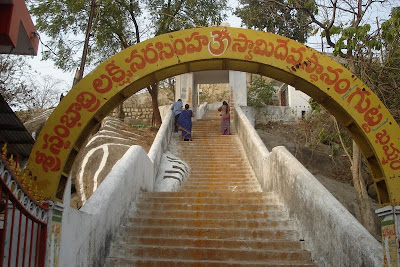
The temple of Sri Narashima Swamy is located in the heart of the Town, which is popularly known to local people as guha gudi. The ancient temple is believed t be existing from Tretha Yuga. The town is located on the banks of the River Munneru, which is tributary to River Krishna.
During Tretha Yugam Mouthgalya Maharishi with his disciples penance here in a cave and he was blessed by Lord Vishnu. Mothgalya Maharishi requested Lord Vishnu to stay back in this place along with Lakshmi. Lord came out of the pillar as Sri Lakshmi Narashima Swamy. Hence the place was known as Sthambadri.
The temple is on a vertical rock which is known as Khamba which means Pillar. The temple is on khamba so it was originally known as Sthamba Sikari which later turned into Sthambadri. At present the place is known as Khammam, which was derived from the word Khammam Mettu.
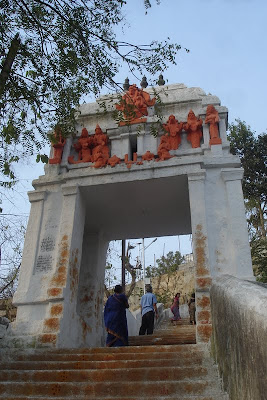
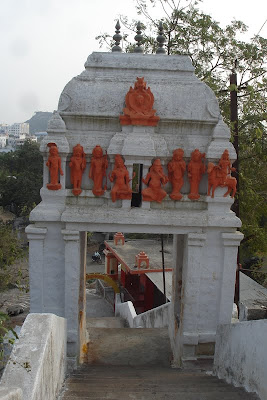
We have to climb steps to reach the temple.
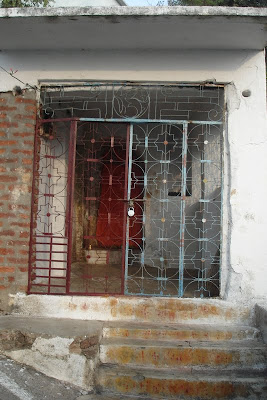
Sri Hanuman sanctum is seen to right side, as we climb the hill.
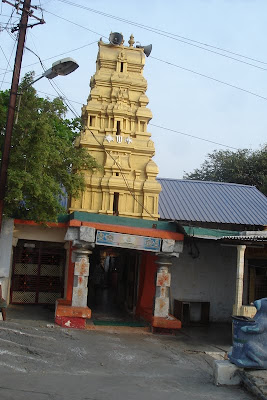
Main Raja Gopuram of three tier.
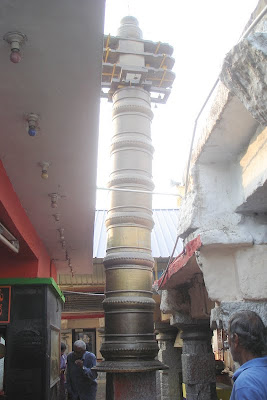
We see dwajasthambam as a rock pillar which is covered with kavacham. Dwajasthambam like this is something Unique.
There is a sanctum for Sri Hanuman near the dwajasthambam.
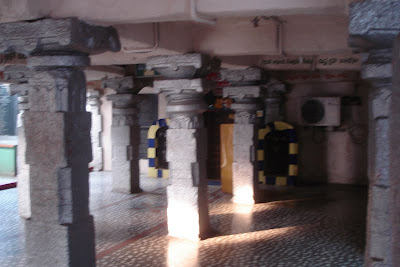
We see a mandapam with 32 pillars.
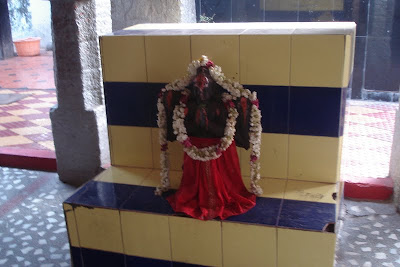
Garuda is seen opposite to, main Garbha Graham within the mandapam.
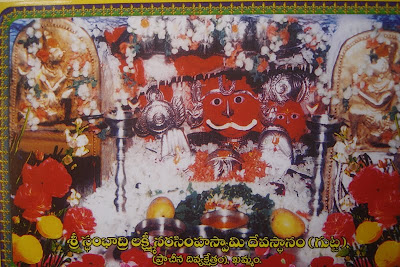
Inner sanctum is a Cave. Sri Narashimar is seen with Thayar. He is seen only up to bust. We see Urchava vigrahas, Aandal, Maharishi idol.
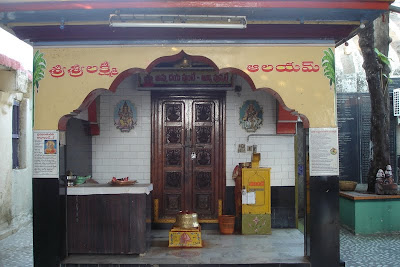
There is a separate sanctum for Sri Lakshmi Thayar.

Paduka is seen in front of Thayar Sannidhi.
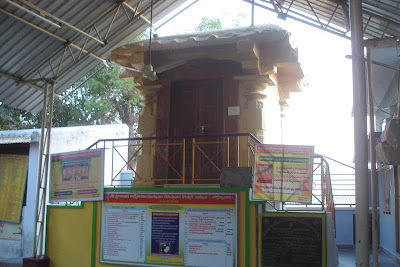
Sayana Graha, of Lord which is known as Addala Mandapam of this temple.
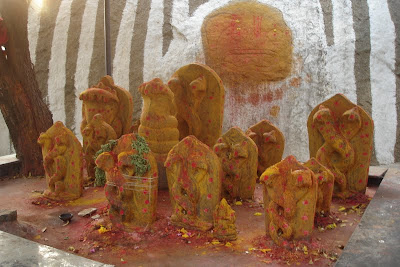
Sthala Purana says in16th century, King Pratapa Rudra, who was ruling the place was blessed by Lord here. King developed the temple and pooja was arranged according to Vaikasana Agama Sthara. Panaka Abishekam on Sundays is important here. Public believe that all their wishes are fulfilled when they worship here the Lord for 40 days.
Wednesday, February 6, 2013
Sthambadri Sri Lakshmi Narashima Swamy Temple, Khammam, AP.

Tuesday, February 5, 2013
Sri Venkateswara Temple, Thirumala Giri, Jaggayyapet.
Venkateswara Swamy
Temple,
Thirumala Giri.
The temple is located on top of hill about 5 kms from
Jaggayyapet, Krishna District,AP. It s about 7kms distance from Chillakallu on
the National High way No-9,from Vijayawada to Hyderabad.
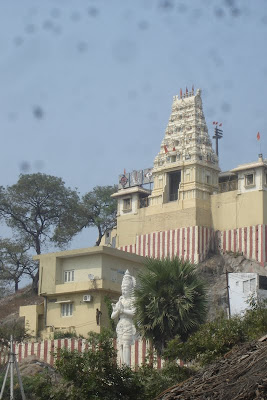
Main Raja Gopuram
of the temple is of five tier.
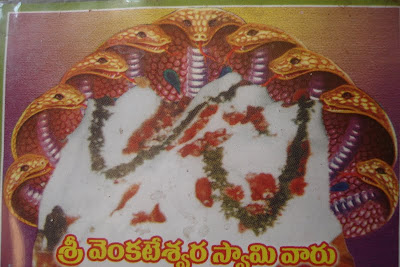
Main Deity of the
temple known as Swayambu Valmikodbhavudu. Here main deity is in the form of Ant
Hill
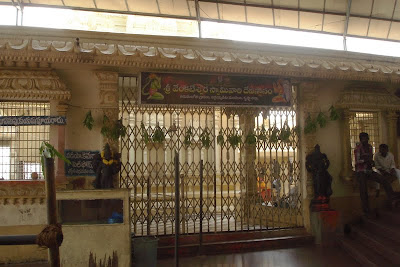
Main entrance to the temple.
Sthala purana says
Baradwaja Maharishi penanced here in Tretha Yuga. Sri Maha Vishnu was
pleased with his penance, and appeared before him to fulfill his desire. Bardwaja Mahrishi earnestly prayed Lord to dwell on the hill forever. His wish
was fulfilled by Lord, who stayed back as Sri
Venkateswara on the hill top.
Both Hill and the
Village, is named as Thirumala giri
The temple is open from 6AM to 6PM only. Poojari says it is
a fact that, Serpants worship Lord Venkateswara, hence the temple is closed
after 6PM. He says milk is kept during the last pooja before shutting the door.
Next morning when the door is opened the vessel is empty. We believe serpants
still worship in the night.
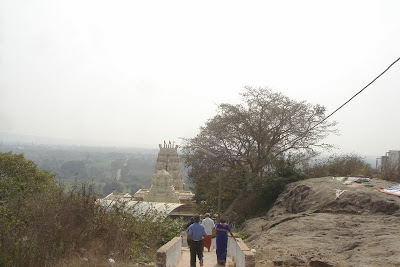
Sri Venkateswara Temple
view from Lord Siva Temple.
From the temple we find few steps which lead us to Mallikarjuna Swamy temple.
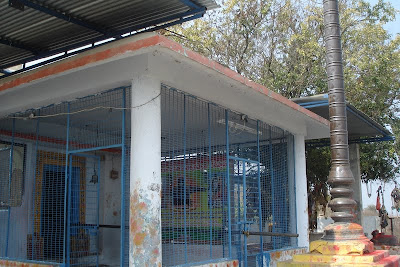
There is a Dwajasthambam
in front of the sanctum and Nandi is
seen in front.
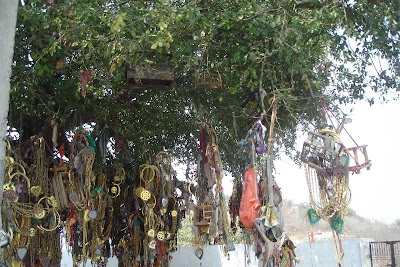
Sthala Vruksham
Sivalingam is
seen inside the sanctum. We see stone idol of Lord Siva with his consort.
Goddess is Bramaramba in this temple.
Goddess is Bramaramba in this temple.
Friday, May 18, 2012
Jogulamba Temple, Alampur, AP
Alampur
Alampur is about 200 kms from Hyderabad on the banks of River Tungabadra in
Mahaboob Nagar district of Andhra Pradesh. River Krishna
and Tungabadra confluence here and the place Alampur is known as Sangama Kshetram
and it is also referred to as Dakshina Kailsam.
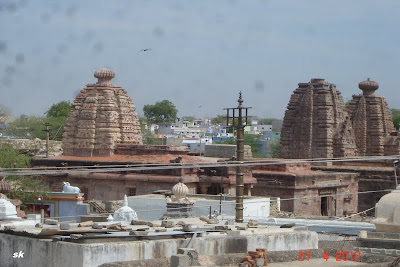
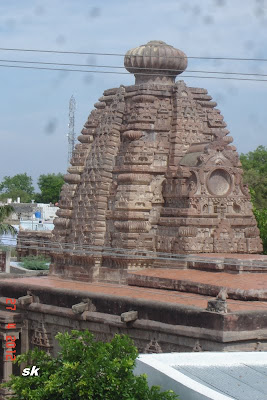
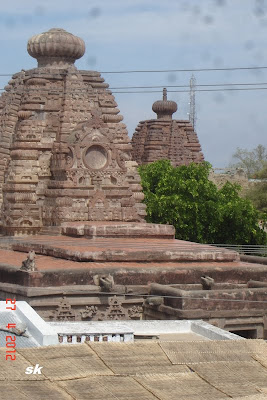
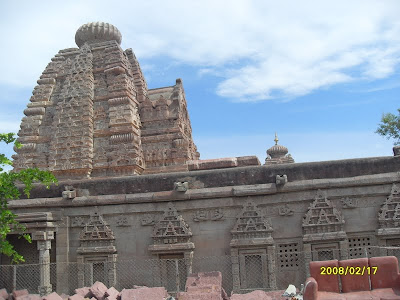
View of temple towers of Nava Brahma,from
River bund.
The temple dates back to 6th Century. We see 9 temples here in
Alampur, known as Nava Brahma dedicated to Lord Siva, built by Badami
Chalukyas. The Nava Brahma temples are Taraka Brahma, Swarga Brahma, Padma
Brahma, Bala Brahma, Garuda Brahma, and Arka Brahma, kumara Brahma, Veera
Brahma and Viswa Brahma.
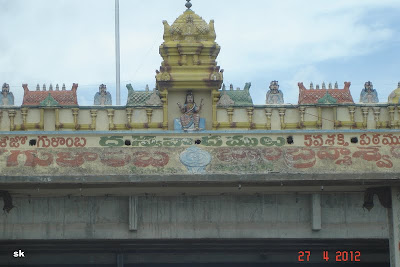
We travel towards Karnool from Hyderabad to reach Alampur. We take a left turn
when it is about 15 kms to reach Karnool. We have a sign board on the
highway.
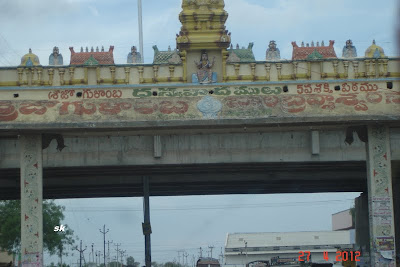
As we travel ahead we see an arch welcoming us to Jogulamba
temple. From there we may have to travel about 12 kms to reach the temple in
Alampur town.
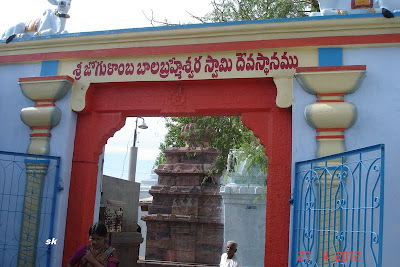
Bala
Brahma Temple is the place, where we enter first.
As we enter inside we see a huge Nandi and two set of padams which is
supposed to be of Lord Siva and Sakthi. Then we enter into a mandapam where we
see idols of Narashimar, Lord Siva and others.
There is a sanctum for Ganesha and next
to it there was a small sanctum with a light. They it was the place where
Goddess was kept.
We see Navagraha’s which are different from the usual type
of idols in other temples.
We enter into Artha mandapam, from where we can see Lord
Siva in Linga form in the main Garbha graham.
Here they say the water poured on Siva Lingam as Abishekam does not flow
out anywhere. With special ticket of Rs300/ for Abishekam, devotees are
permitted inside the main sanctum to perform abishekam.
We see two small idols in sitting posture outside the main
Garbha graham which are called as Chandi and Mundi. These
two idols were originally kept to either sides of Jogulamba. As we go around
the temple sanctum we see many idols.
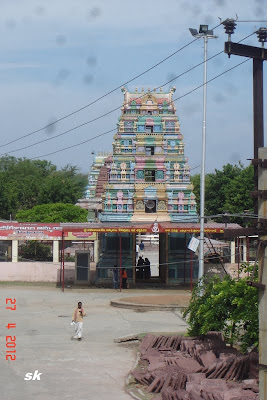
We see south Indian style of temple tower for Jogulamba Temple. The temple was reconstructed in
the year 2005. As per Mythology this is one of the Sakthi peetam,
where “Oordhava Danta Pankthi” (Upper jaw with tooth) of Sati Devi fell here in
this place.
In the year 1930 the temple was demolished by Muslim
invaders. The main idol and consorts were damaged by them. Disfigured idols of
Jogulamba and other Deities were, protected and repaired by devotees who placed
them in Bala Brahma temple.
Goddess Jogulamba is seen in sitting posture. She
is also known as Gruha Chandi.When Aarthy is given one can see Bat, Lizard,
Scorpion and skull adorned in her hair.
As per legand
Maharishi Jamadagni lived with his wife Renuka Devi and his sons
worshiping Bala Brahma Swamy. Renuka matha used to make a pot of mud
daily and used to fetch water for pooja purpose. One day she saw a Gandravas
bathing in River with their wives. She was disturbed by them and was not able
to make a pot on that day, she returned home empty handed. When Jamadagni Muni
came to know about what has happened, in his anger he asked his son to remove
her head. His sons were not ready to do the act and he cursed them. Parasurama
his youngest son agreed to do and he cut the head of his Mother. Muni was
pleased with his son and offered him boon. He prayed his father to give life to
his Brothers and Mother in return for the boon. Life was given to them.
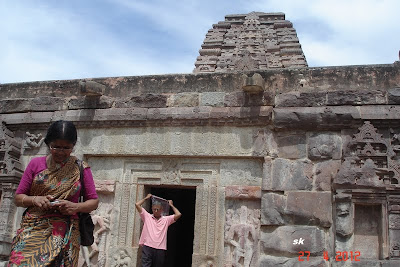
Veera Brahma temple
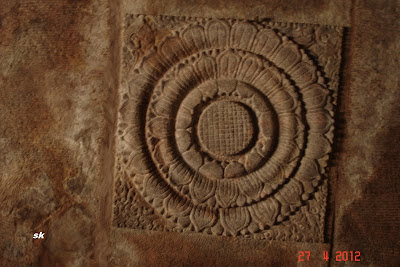
We see Chakkram carved to the inner celing of the artha
mandapam in Veera
brahma Temple.
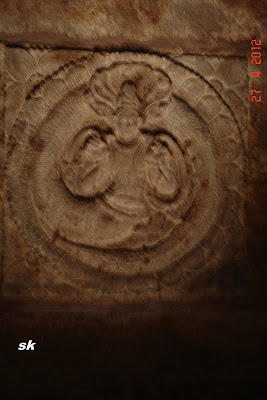
Veera Brahma sculpture carved to the inner celing of the
artha mandapam.
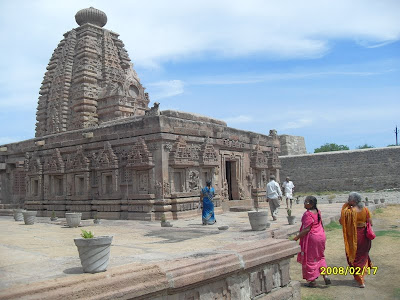
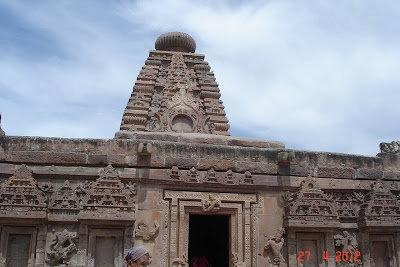
Sri Viswa Brahma Temple.
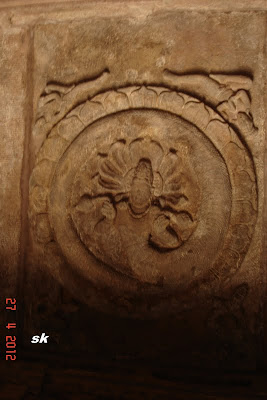
Sri Viswa Brahma Sculpture carved to the inner celing of
temple.
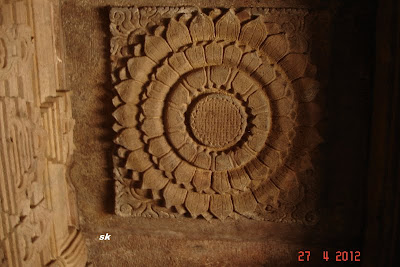
Chakkram, is seen to inner celing of Viswa Brahma
Temple.
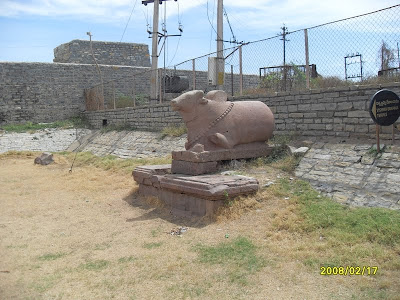
Nandi, seen in front of Sri Viswa Brahma Temple.
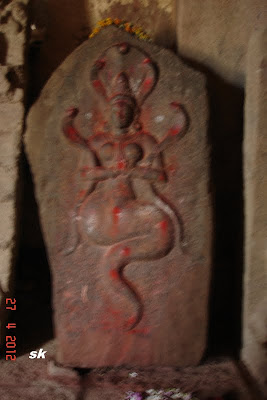
Naga Devata, sculpture seen in Arkka Brahma
Temple.
Subscribe to:
Posts (Atom)


